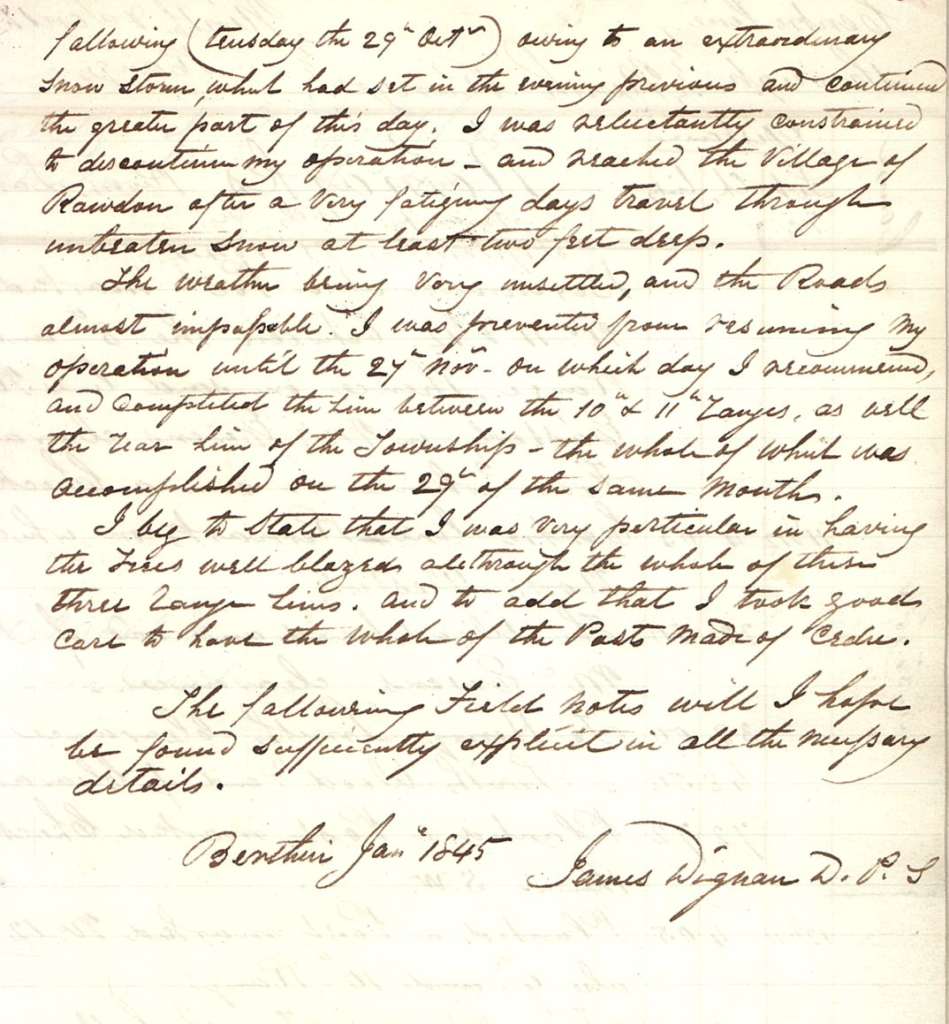
The settlement was initially surveyed as a whole and 11 ranges were identified. Following this the ranges were divided into 28 (10x 20 acre) lots.
Sectors to be granted to the Church of England, (the only church established in the British territory) were assigned and the remaing lots to be granted to settlers.
The original survey for the Rawdon Settlement was completed by Samuel Holland. After Holland’s death his nephew Joseph Bouchette inherited his uncle’ office and continued the survey for ranges and lots.
Joseph Bouchette’s 124 Survey
Rawdon, Kildare, & Kilkenny
I then proceeded to the visit and inspection of Rawdon, Kildare , and Kilkenny, on which subject I had the honour to report from Montreal, accompanying the same with a communication dated 24th August last, together with numerous documents touching the inquiries personally conducted by me then, and reported upon severally.
I would therefore beg leave to refer thereto so far as they extend, and in embody in this general report such further observations, respecting the state of those townships, and their relative situation with the adjacent Seigneuries, to me appear necessary, commencing with Rawdon.
This township is bounded in front by the rear lines of the Seigneury of l’Assomption and La Chenaie, from which there are roads leading into the township. It is singular to remark, that, notwithstanding the limits between the Seigneuries and this township have been established and marked in the field by actual survey, this Seigneury has considerably encroached upon the first range of Rawdon, where he has placed Censitaires under Seignorial titles.
The encroachments in question extending as well to the crown and clergy reservations in that range as to the track granted under letters patent to the Bruyeres, I have in consequence subjoined, for the information of his majesties government, a plan and other documents, illustrative of the State of the case, under letter B.
The township of Rawdon is of the usual dimensions of a regular inland Township, that is, 10 miles square; it has been subdivided into 11 ranges, and each range into 28 lots of 200 acres. The new system of laying out the crown and clergy reserves in Blocks has been extended thereto, except in the first and the part of the second ranges, already granted under patent, in which the reserves were appropriated.
The face of the country in this township is uneven, and in many parts mountainous, from the fourth Range northward. The soil therein, generally, is fit for the cultivation of every species of grain peculiar to this country, and, in various sections, susceptible of the growth and culture of hemp and flax. It contains several small lakes, and is well watered by the River Ouareau and numerous other streams, by which it is traversed and on which are to be found many mill sites. In fact, this Township, as well as those adjoining and lying in that direction, offer many temptations as a fine ” pasturing and grazing country”, to use the language of its inhabitants, and possesses, at the same time, the no inconsiderable advantage of the proximity of a large and populous market Town.
Previous to closing this branch of my report, it may not be improper to notice the advantages derived by the inhabitants of this Township from Mr. Dugas’ excellent grist and sawmills, from whence the road winds into and traverses the interior of the township up to the seventh range.
Upon leaving Mr. McKenzie’s Mills, better known by the name of Manchester Mills, so called after the individual who conducts them, situated about 1 mile south of Dugas’ establishment, I was obliged to take a very circuitous route of about 20 miles to reach the Emmigrant Settlement, in the Township of Kildare, whither my attention was in the next instance directed, whilst by traversing that Township and part of Rawdon, the distance does not exceed 8 miles, one third thereof is only a foot path. The path traveled winds along the banks of the River Ouareau , on upon which there were several grist and sawmills, intervals of one and two leagues. Continuing this road for a distance of about two leagues and a half, we took the road which leads to the River Rouge settlement.
With respect to the state of the population, (composed chiefly of emigrants from Ireland,] and general improvement, I beg leave to refer to the accompanying statement, No. 1 and Will only observe common that the settlements therein have appeared to me in a state of tolerable advancement and progress, considering the disadvantages under which the inhabitants have laboured, from the various causes stated in my former report. I shall only state, in addition there too, that Mr. Alexander Rea was appointed agent for the superintendency of Rawdon, in May 1821, and that he had previously obtained, for himself and a long list of applicants an Order of council for grants of 100 acres to each of them, to be located in this Township and in Killdare. Upon that order several of those individuals were like located to lands in Rawdon from this office; the others received their location tickets from Mr. Rhea, as agent, in which capacity he appears to have conducted the settlement of the Township under his inspection was somewhat more regularity than system than Captain Colclough, who succeeded to him in 1823. This circumstance may not, however, invalidate the just cause of complaining which has produced Mr. Rea’s removal–but, at that time, it was expected the appointment of another agent would be the means of obviating the difficulties complained of and introduce more order and harmony and a better understanding amongst the settlers. Although it may be a troublesome and embarrassing task, owing to the description and character of some of the people in that settlement, yet it might and ought to have been effected.
1826 J. Sullivan Survey

This survey included lots 12 to 28, ranges 7 & 8.
Surveyors, such as Dignan, followed. Copies of their survey reports give details of the land as well as settlers and the progress of clearing being done on the lot..
Surveyor reports were consulted before issuing letters of patent to potential applicants.
Surveys were definitely not a walk in the park. They consisted of a group of men, including aboriginals as guides, equipped for an extended expedition into thick virgin forests for a month or more carrying all the food and equipment.
1824 Joseph Bouchette’s Survey Report
Rawdon, Kildare, & Kilkenny
I then proceeded to the visit and inspection of Rawdon, Kildare , and Kilkenny, on which subject I had the honour to report from Montreal, accompanying the same with a communication dated 24th August last, together with numerous documents touching the inquiries personally conducted by me then, and reported upon severally. I would therefore beg leave to refer thereto so far as they extend, and in embody in this general report such further observations, respecting the state of those townships, and their relative situation with the adjacent Seigneuries, to me appear necessary, commencing with Rawdon.
This township is bounded in front by the rear lines of the Seigneury of l’Assomption and La Chenaie, from which there are roads leading into the township. It is singular to remark, that, notwithstanding the limits between the Seigneuries and this township have been established and marked in the field by actual survey, this Seigneury has considerably encroached upon the first range of Rawdon, where he has placed Censitaires under Seignorial titles. The encroachments in question extending as well to the crown and clergy reservations in that range as to the track granted under letters patent to the Bruyeres, I have in consequence subjoined, for the information of his majesties government, a plan and other documents, illustrative of the State of the case, under letter B.
The township of Rawdon is of the usual dimensions of a regular inland Township, that is, 10 miles square; it has been subdivided into 11 ranges, and each range into 28 lots of 200 acres. The new system of laying out the crown and clergy reserves in Blocks has been extended thereto, except in the first and the part of the second ranges, already granted under patent, in which the reserves were appropriated.
The face of the country in this township is uneven, and in many parts mountainous, from the fourth Range northward. The soil therein, generally, is fit for the cultivation of every species of grain peculiar to this country, and, in various sections, susceptible of the growth and culture of hemp and flax. It contains several small lakes, and is well watered by the River Ouareau and numerous other streams, by which it is traversed and on which are to be found many mill sites. In fact, this Township, as well as those adjoining and lying in that direction, offer many temptations as a fine ” pasturing and grazing country”, to use the language of its inhabitants, and possesses, at the same time, the no inconsiderable advantage of the proximity of a large and populous market Town.
With respect to the state of the population, (composed chiefly of emigrants from Ireland,] and general improvement, I beg leave to refer to the accompanying statement, No. 1 and Will only observe common that the settlements therein have appeared to me in a state of tolerable advancement and progress, considering the disadvantages under which the inhabitants have laboured, from the various causes stated in my former report. I shall only state, in addition there too, that Mr. Alexander Rea was appointed agent for the superintendency of Rawdon, in May 1821, and that he had previously obtained, for himself and a long list of applicants an Order of council for grants of 100 acres to each of them, to be located in this Township and in Killdare. Upon that order several of those individuals were like located to lands in Rawdon from this office; the others received their location tickets from Mr. Rhea, as agent, in which capacity he appears to have conducted the settlement of the Township under his inspection was somewhat more regularity than system than Captain Colclough, who succeeded to him in 1823. This circumstance may not, however, invalidate the just cause of complaining which has produced Mr. Rea’s removal–but, at that time, it was expected the appointment of another agent would be the means of obviating the difficulties complained of and introduce more order and harmony and a better understanding amongst the settlers. Although it may be a troublesome and embarrassing task, owing to the description and character of some of the people in that settlement, yet it might and ought to have been effected.
Previous to closing this branch of my report, it may not be improper to notice the advantages derived by the inhabitants of this Township from Mr. Dugas’ excellent grist and sawmills, from whence the road winds into and traverses the interior of the township up to the seventh range.
Upon leaving Mr. McKenzie’s Mills, better known by the name of Manchester Mills, so called after the individual who conducts them, situate about 1 mile south of Dugas’ establishment, I was obliged to take a very circuitous route of about 20 miles to reach the Emmigrant Settlement, in the Township of Killdare, whither my attention was in the next instance directed, whilst by traversing that Township and part of Rawdon, the distance does not exceed 8 miles, one third thereof is only a foot path. We traveled winds along the banks of the River Ouareau , on upon which there were several grist and sawmills, intervals of one and two leagues. Continuing this road for a distance of about two leagues and a half, we took the road which leads to the River Rouge settlement.
1844 Dignan Survey
An area chosen for settlement was surveyed before lots were assigned to settlers. The original survey for the Rawdon Settlement was completed by Samuel Holland. After Holland’s death his nephew Joseph Bouchette inherited his uncle’ office and continued the survey for ranges and lots.
Other surveyors, such as Dignan, followed. Copies of their survey reports give details of the land as well as settlers and the progress of clearing being done.
Surveyor reports were consulted before issuing letters of patent to potential applicants.
Surveys were definitely not a walk in the park. They consisted of a group of men, including aboriginals as guides, equipped for an extended expedition into thick virgin forests for a month or more carrying all the food and equipment.
1824 Surveyor’s Report
Rawdon, Kildare, & Kilkenny
I then proceeded to the visit and inspection of Rawdon, Kildare , and Kilkenny, on which subject I had the honour to report from Montreal, accompanying the same with a communication dated 24th August last, together with numerous documents touching the inquiries personally conducted by me then, and reported upon severally. I would therefore beg leave to refer thereto so far as they extend, and in embody in this general report such further observations, respecting the state of those townships, and their relative situation with the adjacent Seigneuries, to me appear necessary, commencing with Rawdon.
This township is bounded in front by the rear lines of the Seigneury of l’Assomption and La Chenaie, from which there are roads leading into the township. It is singular to remark, that, notwithstanding the limits between the Seigneuries and this township have been established and marked in the field by actual survey, this Seigneury has considerably encroached upon the first range of Rawdon, where he has placed Censitaires under Seignorial titles. The encroachments in question extending as well to the crown and clergy reservations in that range as to the track granted under letters patent to the Bruyeres, I have in consequence subjoined, for the information of his majesties government, a plan and other documents, illustrative of the State of the case, under letter B.
The township of Rawdon is of the usual dimensions of a regular inland Township, that is, 10 miles square; it has been subdivided into 11 ranges, and each range into 28 lots of 200 acres. The new system of laying out the crown and clergy reserves in Blocks has been extended thereto, except in the first and the part of the second ranges, already granted under patent, in which the reserves were appropriated.
The face of the country in this township is uneven, and in many parts mountainous, from the fourth Range northward. The soil therein, generally, is fit for the cultivation of every species of grain peculiar to this country, and, in various sections, susceptible of the growth and culture of hemp and flax. It contains several small lakes, and is well watered by the River Ouareau and numerous other streams, by which it is traversed and on which are to be found many mill sites. In fact, this Township, as well as those adjoining and lying in that direction, offer many temptations as a fine ” pasturing and grazing country”, to use the language of its inhabitants, and possesses, at the same time, the no inconsiderable advantage of the proximity of a large and populous market Town.
With respect to the state of the population, (composed chiefly of emigrants from Ireland,] and general improvement, I beg leave to refer to the accompanying statement, No. 1 and Will only observe common that the settlements therein have appeared to me in a state of tolerable advancement and progress, considering the disadvantages under which the inhabitants have laboured, from the various causes stated in my former report. I shall only state, in addition there too, that Mr. Alexander Rea was appointed agent for the superintendency of Rawdon, in May 1821, and that he had previously obtained, for himself and a long list of applicants an Order of council for grants of 100 acres to each of them, to be located in this Township and in Killdare. Upon that order several of those individuals were like located to lands in Rawdon from this office; the others received their location tickets from Mr. Rhea, as agent, in which capacity he appears to have conducted the settlement of the Township under his inspection was somewhat more regularity than system than Captain Colclough, who succeeded to him in 1823. This circumstance may not, however, invalidate the just cause of complaining which has produced Mr. Rea’s removal–but, at that time, it was expected the appointment of another agent would be the means of obviating the difficulties complained of and introduce more order and harmony and a better understanding amongst the settlers. Although it may be a troublesome and embarrassing task, owing to the description and character of some of the people in that settlement, yet it might and ought to have been effected.
Previous to closing this branch of my report, it may not be improper to notice the advantages derived by the inhabitants of this Township from Mr. Dugas’ excellent grist and sawmills, from whence the road winds into and traverses the interior of the township up to the seventh range.
Upon leaving Mr. McKenzie’s Mills, better known by the name of Manchester Mills, so called after the individual who conducts them, situate about 1 mile south of Dugas’ establishment, I was obliged to take a very circuitous route of about 20 miles to reach the Emmigrant Settlement, in the Township of Killdare, whither my attention was in the next instance directed, whilst by traversing that Township and part of Rawdon, the distance does not exceed 8 miles, one third thereof is only a foot path. We traveled winds along the banks of the River Ouareau , on upon which there were several grist and sawmills, intervals of one and two leagues. Continuing this road for a distance of about two leagues and a half, we took the road which leads to the River Rouge settlement.
1844 Dignans Survey
An area chosen for settlement was surveyed before lots were assigned to settlers. The original survey for the Rawdon Settlement was completed by Samuel Holland. After Holland’s death his nephew Joseph Bouchette inherited his uncle’ office and continued the survey for ranges and lots.
Other surveyors, such as Dignan, followed. Copies of their survey reports give details of the land as well as settlers and the progress of clearing being done.
Surveyor reports were consulted before issuing letters of patent to potential applicants.
Surveys were definitely not a walk in the park. They consisted of a group of men, including aboriginals as guides, equipped for an extended expedition into thick virgin forests for a month or more carrying all the food and equipment.
Rawdon, Kildare, & Kilkenny
I then proceeded to the visit and inspection of Rawdon, Kildare , and Kilkenny, on which subject I had the honour to report from Montreal, accompanying the same with a communication dated 24th August last, together with numerous documents touching the inquiries personally conducted by me then, and reported upon severally. I would therefore beg leave to refer thereto so far as they extend, and in embody in this general report such further observations, respecting the state of those townships, and their relative situation with the adjacent Seigneuries, to me appear necessary, commencing with Rawdon.
This township is bounded in front by the rear lines of the Seigneury of l’Assomption and La Chenaie, from which there are roads leading into the township. It is singular to remark, that, notwithstanding the limits between the Seigneuries and this township have been established and marked in the field by actual survey, this Seigneury has considerably encroached upon the first range of Rawdon, where he has placed Censitaires under Seignorial titles. The encroachments in question extending as well to the crown and clergy reservations in that range as to the track granted under letters patent to the Bruyeres, I have in consequence subjoined, for the information of his majesties government, a plan and other documents, illustrative of the State of the case, under letter B.
The township of Rawdon is of the usual dimensions of a regular inland Township, that is, 10 miles square; it has been subdivided into 11 ranges, and each range into 28 lots of 200 acres. The new system of laying out the crown and clergy reserves in Blocks has been extended thereto, except in the first and the part of the second ranges, already granted under patent, in which the reserves were appropriated.
The face of the country in this township is uneven, and in many parts mountainous, from the fourth Range northward. The soil therein, generally, is fit for the cultivation of every species of grain peculiar to this country, and, in various sections, susceptible of the growth and culture of hemp and flax. It contains several small lakes, and is well watered by the River Ouareau and numerous other streams, by which it is traversed and on which are to be found many mill sites. In fact, this Township, as well as those adjoining and lying in that direction, offer many temptations as a fine ” pasturing and grazing country”, to use the language of its inhabitants, and possesses, at the same time, the no inconsiderable advantage of the proximity of a large and populous market Town.
With respect to the state of the population, (composed chiefly of emigrants from Ireland,] and general improvement, I beg leave to refer to the accompanying statement, No. 1 and Will only observe common that the settlements therein have appeared to me in a state of tolerable advancement and progress, considering the disadvantages under which the inhabitants have laboured, from the various causes stated in my former report. I shall only state, in addition there too, that Mr. Alexander Rea was appointed agent for the superintendency of Rawdon, in May 1821, and that he had previously obtained, for himself and a long list of applicants an Order of council for grants of 100 acres to each of them, to be located in this Township and in Killdare. Upon that order several of those individuals were like located to lands in Rawdon from this office; the others received their location tickets from Mr. Rhea, as agent, in which capacity he appears to have conducted the settlement of the Township under his inspection was somewhat more regularity than system than Captain Colclough, who succeeded to him in 1823. This circumstance may not, however, invalidate the just cause of complaining which has produced Mr. Rea’s removal–but, at that time, it was expected the appointment of another agent would be the means of obviating the difficulties complained of and introduce more order and harmony and a better understanding amongst the settlers. Although it may be a troublesome and embarrassing task, owing to the description and character of some of the people in that settlement, yet it might and ought to have been effected.
Previous to closing this branch of my report, it may not be improper to notice the advantages derived by the inhabitants of this Township from Mr. Dugas’ excellent grist and sawmills, from whence the road winds into and traverses the interior of the township up to the seventh range.
Upon leaving Mr. McKenzie’s Mills, better known by the name of Manchester Mills, so called after the individual who conducts them, situate about 1 mile south of Dugas’ establishment, I was obliged to take a very circuitous route of about 20 miles to reach the Emmigrant Settlement, in the Township of Killdare, whither my attention was in the next instance directed, whilst by traversing that Township and part of Rawdon, the distance does not exceed 8 miles, one third thereof is only a foot path. We traveled winds along the banks of the River Ouareau , on upon which there were several grist and sawmills, intervals of one and two leagues. Continuing this road for a distance of about two leagues and a half, we took the road which leads to the River Rouge settlement.
1844 Dignan Report