
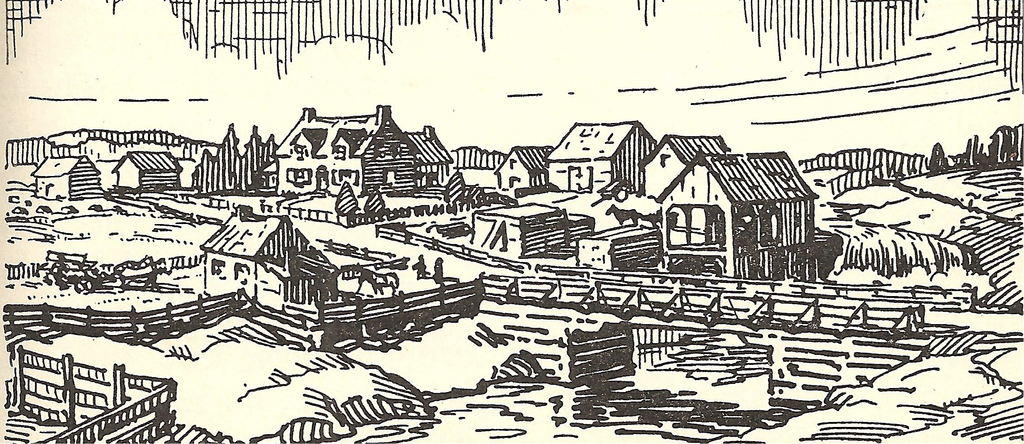
In 1798, Richard Holland, a government surveyor, subdivided the first two Ranges of Rawdon into 28 lots of 200 acres each. Rawdon Township was given its patents July 17, 1799.
Rawdon was the ninth Township, the first the north of the St. Lawrence, to be settled under the English regime. It bordered on the St Sulpice, l’Assomption, and LaChenaie Seigneuries.
In 1822 there were about 15 or 20 other families in the Township of Rawdon, mostly on the lower ranges. These were mostly Empire Loyalists who had a history of settlement south of the new border. European arrivals, totally inexperienced in the realities of settlement in a new faced a new, often harsh, reality.
The extreme weather conditions in Lower Canada required adaption to not only to the climate, but the limited commodities available, and political realities such as no direct government.
Townships were governed from Quebec City, local administration was dependant on government appointed representatives chosen by officials in Quebec City. Usually these were local men appointed land agents and justices of the peace.
A circuit court ran through the settlements to try cases that were beyond the jurisdiction of the local justices of peace. The court for the Rawdon Settlement was based in Berthierville, official documents were also kept in the courthouse there.
Unfortunately a fire destroyed the documents. A new building was built in Ste. Julienne to replace the depository where it remained for more than 100 years before being moved to archives in l’Assomption.
A move to open up an untouched sector of virgin forest was truly an adventure.
Quebec City, was 300 years old, and Montreal, 200 years old, were both well established with all the conveniences and services readily available.
Settling outside these areas, such as the Township of Rawdon lacked both public services and community organizations. There was no village, no church, no school, no doctor, no post office, just a large, thick forest and three or four feet of undewrbrush.
Well sharpened axes were the only tool to clear a lot for building and seeding to fulfill the requrements needed to receive Letters Patent. (It was 1885 before saws to fell trees were created.)