
The Treaty of Paris
Great Britain 1811
To understand life in Great Britain at this time an understanding of the conditions of life at this time is essential.
Just as our world is quickly changing in this the 21st century, so it was as the eighteenth century drew to a close.
The nineteenth century loomed into view with a promise of better things to come for some, while for others many foresaw severe hardships.
The invention of the steam engine altered the workforce creating what became known as the Industrial age. Industries, no longer required water to produce power were no longer limited to a source of water. Smoke stacks factories wereb now belching black smoke that settled on nearby roof tops and in peoples’ lungs causing an alarming increase in respiratory ailments as well as other associated health problems.
Pollution became a concern for many. Crowding in towns and cities created a crisis in housing and the water supply. Poor sanitation practices spread contamination and typhoid which were soon rampant. Beer became the beverage of choice and micro-breweries sprang up all over the country to supply the market as the fear of drinking water increased.
Roads were being improved to allow for faster, easier, transport of for the people manufactured goods to all corners of Great Britain and its seaports. The development of territories in the New World greatly enhanced exports and imports.
Comfort and speed in stage coaches also improved noticeably as did the size of carriages that now carried as many as eight passengers on the new McAdam or hardtop roads.
The turn of the century also brought steam locomotives which travelled on rails as well as steam boats that plied the seas without being dependant on fickle winds to carry them along. The installation of railroads often caused sharp controversy in many communities but they continued to persevere in many areas.
Although the ratio was swiftly changing, there were still more people employed in cottage industries than in factories. Records show the years between 1782-1821 to be the period with the worst conditions for the cottage workers. Those such as lace and stocking weavers worked from their homes. The materials were usually leased from a hosier who supplied the raw material and bought the finished product back. This led to much abuse by the hosier yet the workers had no recourse
Science was advancing, with France leading this field. Encouraged by Napoleon Bonaparte the pursuit of scientific study was encouraged with issuing medals to those who actually published their theories. The term ‘biology’ was coined in 1790 by Jean Baptiste Lamarck who developed a system of classification for the study of biology as well as a theory of adaption.
Pierre Simon Laplace’s mechanical theory of the universe in 1796 resulted in chaos for workers and wealth for management.
Joseph Fourrier developed the theory of heat and in 1804 Joseph-Louis Gay-Lussac went 23,012 feet up in a balloon to measure the effects of altitude on terrestrial gravity.
Great strides were also being made in the study of medicine. Leopold Auenbrugger introduced the use of percussion for diagnosing chest and heart ailments and published a report of his findings in 1760. One of his pupils, Réné Théophile Laennec invented the first rather primitive stethoscope about 1806 and later published the results of his studies. His work on the thoracic organs, especially the treatise on pneumonia, remained a classic for the next hundred years.
Philip Pinel who was the medical director of the Richelieu Asylum in France in 1792 , was the first person to practice humane methods of treatment for the insane. Pinel tried various approaches to finding a cure for some of the patients. He reduced the blood letting and drugs that were standard treatment at that time, and added a regime of fresh air and exercise rather than incarceration in chains.
He published a paper on his ideals and methods that soon became a standard in the treatment of the mentally ill. The French institute for the mentally ill in Montreal was named for this very man as well as a street.
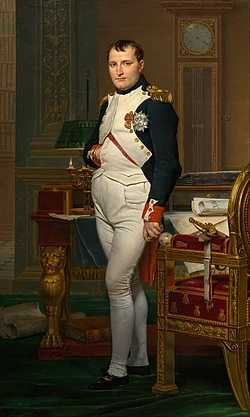
Meanwhile “that dreadful little man” as Napolean Bonaparte was referred to in England, was waging war throughout Europe.
Napoleon’s rampage disrupted England’s trade with Europe. This had direct and severe consequences on the English economy. Bankruptcies and job losses resulted causing desperate poverty among the tradesmen and working classes. To combat this loss of trade, markets were expanded to the New World and the shipping industry took hold.
To bolster the morale of the English, patriotism was fanned to a frenzy.
Stories were told, poems were written and ballads sung about the exploits of England’s finest. He might conquer the Continent, but that “little upstart Corsican” was not going to beat the English down!
England was destitute, many of its people near starvation, but it still held firm against the invader. When Napoleon instituted a blockade, England found the means of supplying its own food. Industry was geared to local consumption. Trade embargoes, bankruptcies, heavy taxes– nothing would make England bow down to his threat.
The navy, with Nelson (1758-1805) as its leader, captured not only the enemy but the imagination and admiration of the whole nation. Like Bonaparte, he was not a big man but what he lacked in stature he made up for in colour. His naval career started at the young age of 12 years old and by the age of twenty he was captain of his ship. He had already served in the Arctic as well as the East and West Indies.
In 1793 when war broke out between England and France it fell to Nelson to blockade the French forces which he did quit successfully. There were never enough volunteers to man the navy’s ships so “His Majesty’s Press Gang” was sent out to conscript sailors for Nelson’s ships. Men without means were “pressed into service” as well as vagrants and many others unlucky enough to be picked up.
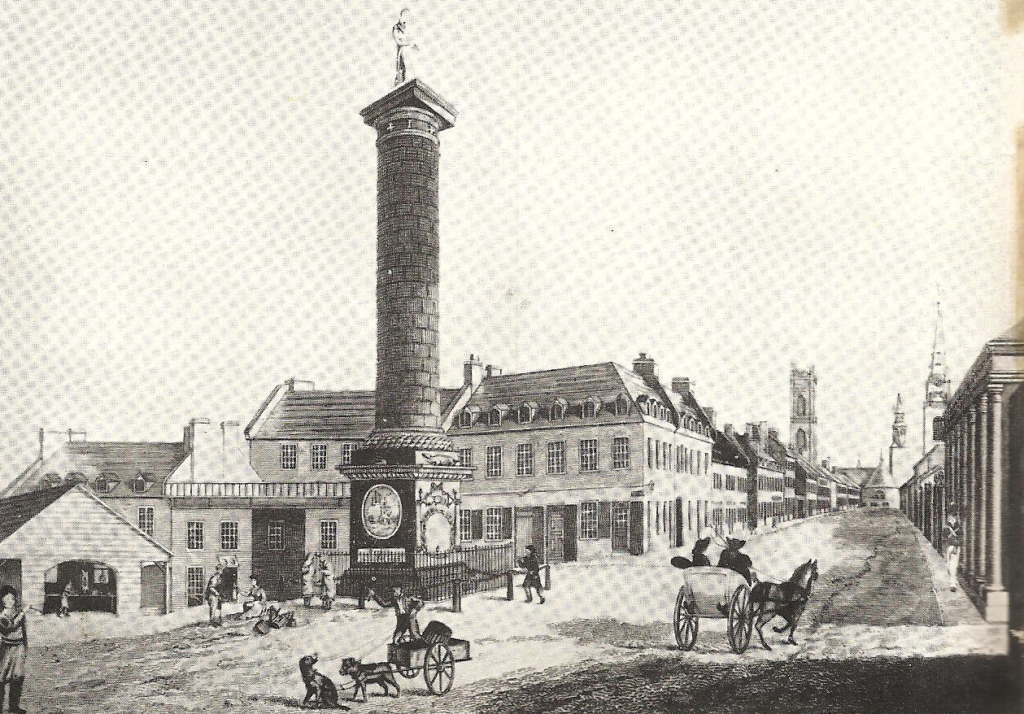
In different battles Nelson first lost an eye, then an arm, but he continued to lead the Royal Navy to victory against France and their ally, Spain. He was promoted to vice-admiral and then made a viscount for his efforts. His final victory in 1805 cost him his life, but he was buried with full honours and recognized as a national hero. Today his final victory is still celebrated on Trafalgar Day and monuments to him still stand, including one in downtown Montreal which has recently been refurbished.