
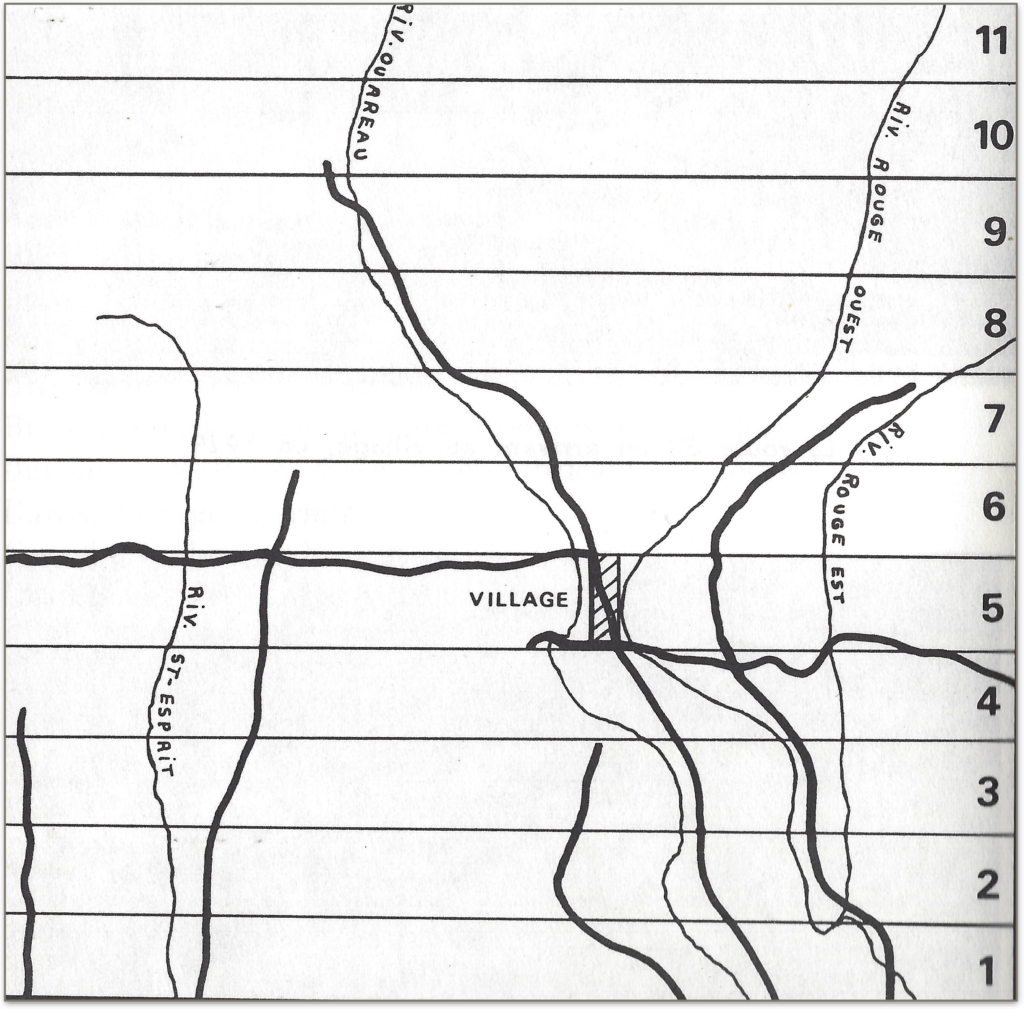
Two roads led up through the township. The first road started the 1st range at Philemon Dugas’ mill on the Red River. The other a mile farther down the Oureau River at Manchester’s mill.
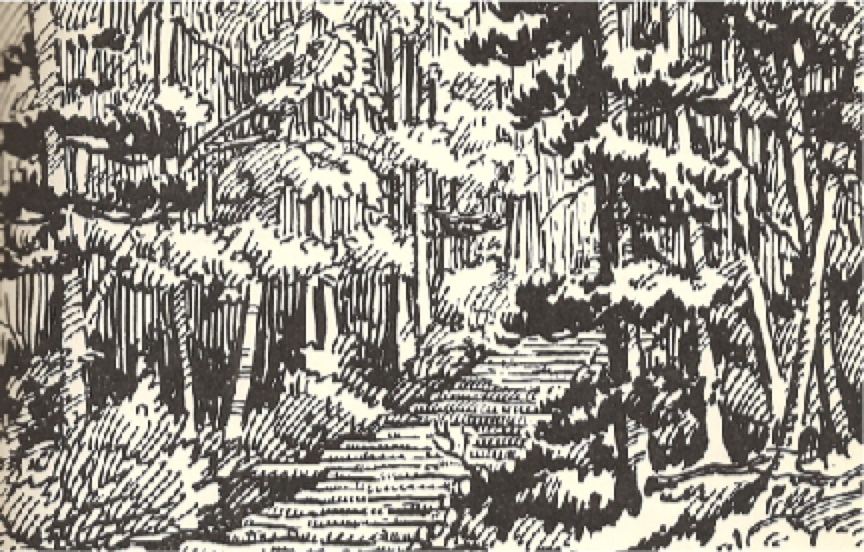
Early roads, the best were comparable to bush roads a hundred years later studded with deep ruts, stumps, and rocks. A walk or ride along road was definitely not an easy challenge..
Although the roads led to the upper ranges of the Township, only those on the first ranges were passable by other than on foot.
The upper ends of these so called roads were merely tracks through the bush.
This tree bridge across a narrow waterway was sometimes the only crossing on the road. Should a bridge be built a further along the water edge it could save a few steps for those travelling on foot.
The particularities of the topography made it difficult to forge roads in many places.
Sandy soil washed away in heavy rain, clay soil became extremely greasy. As of the 4th range, where the mountain began to rise, rocks and hills posed challenges.
As the settlement evolved settlers were obliged to clear and maintain a road along, or sometimes on, their lot for public use.
Several rivers , large and small, also limited the choices available to build roads.
Swampy areas around the watery areas also challenged those wishing to pass. Corduroy roads were laid in swampy areas.
Corduroy Road Through Swampy Areas
Boggy or swampy areas, of which there were many in the Townships, were traversed on a corduroy road. These roads were small logs laid side-by-side in the mud.
Roads themselves strewn with rocks, tree roots and stumps challenged both pedestrians and wagons.
Corduroy roads and bridges were approached with caution. To prevent any misadventure misplaced logs must be realigned before crossing.
As the logs were not secured they rolled as a wagon passed over them adding to the jolt of crossing on logs. When the discomfort became unbearable walking behind the load was a tempting option.
In the case of a particularily heavy load or a steep grade walking, sometimes pushing, was a reqirement.
There was always the hazard of sliding into a tree alongside the road or the wagon upsetting strewing both the load and passengers the the ground.
Wagons and sleighs suffered much damage on the roads breakage and required repair before they could continue on their way.
An axe was always kept attached to a back post of conveyances to repair damages and clear the road of any fallen trees or branches blocking the road or to replace a log on a corduroy road or bridge.
In 1960 these roads and bridges were still being used in Northern Ontario.
Crossing Streams or Rivers
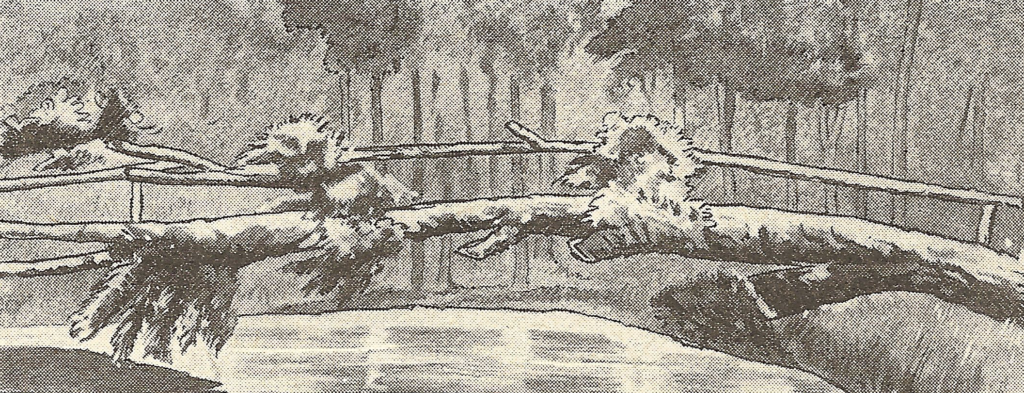
The smaller streams were forded, or where this was impossible where a steep bank prevented fording, a fallen tree with the branches still intact was laid across the awning banks. This was for a footpath only, a road had to be diverted elsewhere.
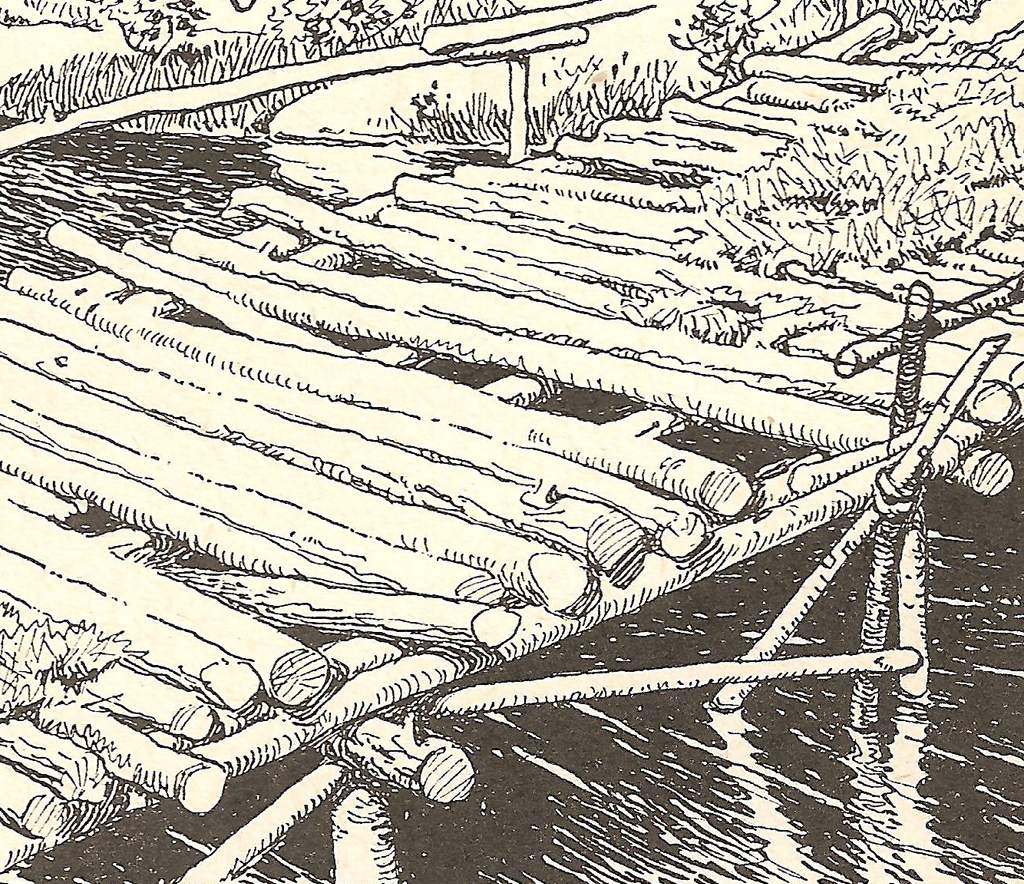
As the forest trails slowly became roads, wider bridges were built on much of the same principal as the corduroy roads. Poles or saplings were laid crossways on tree trunks supported by posts driven into the bed of the stream. The cross poles were then covered with moss or earth.
These bridges were always insecure and often dangerous. The poles rotted or broke, leaving gaping holes which could break the leg of an ox, horse, or man if they failed to notice the danger. Heavy rains washed off the earth and high water in spring swept bridges away entirely.
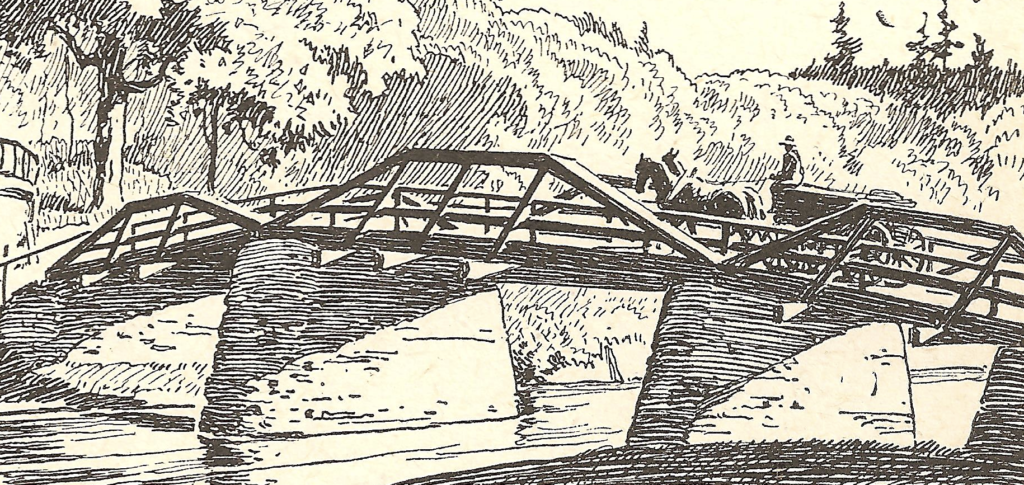
As time went on experience relative to the forces of nature in the Canadas the construction of bridges was improved to offer safety and security. Bases built of flat rocks, which were plentiful in the settlement, were raised higher to accommodade heavy rain and spring floods. Loose logs for the platform were replaced with planks dovetailed and fitted together.